

You have a brilliant idea for a restaurant. Maybe it is a fast-casual bowl concept, a neighbourhood bakery, or a food truck with a twist. The next step feels obvious: find a location, sign a lease, and start building. But that lease is the most expensive decision you will make, and rushing into it is the #1 reason new foodservice businesses fail within the first year.
This guide walks you through a proven validation process that will save you months of heartache and thousands of euros before you sign on the dotted line.
Step 1: Define Your Concept on Paper
Before you look at a single property, you need to articulate exactly what you are building. A vague idea leads to vague results. Write down:
Concept type: Quick service, full service, café, ghost kitchen, food truck?
Cuisine / offering: What specific food or drink are you known for?
Price point: Per-person average spend (e.g. €8-12 lunch, €25-40 dinner).
Service model: Counter service, table service, hybrid, takeout-focused?
Target customer: Who are they? Office workers, families, students, tourists?
💡 Tip: Reality check: If you cannot describe your concept in one sentence, it is not ready for a lease. Example: "A quick-service bowl bar serving healthy lunches under €12 to downtown office workers."
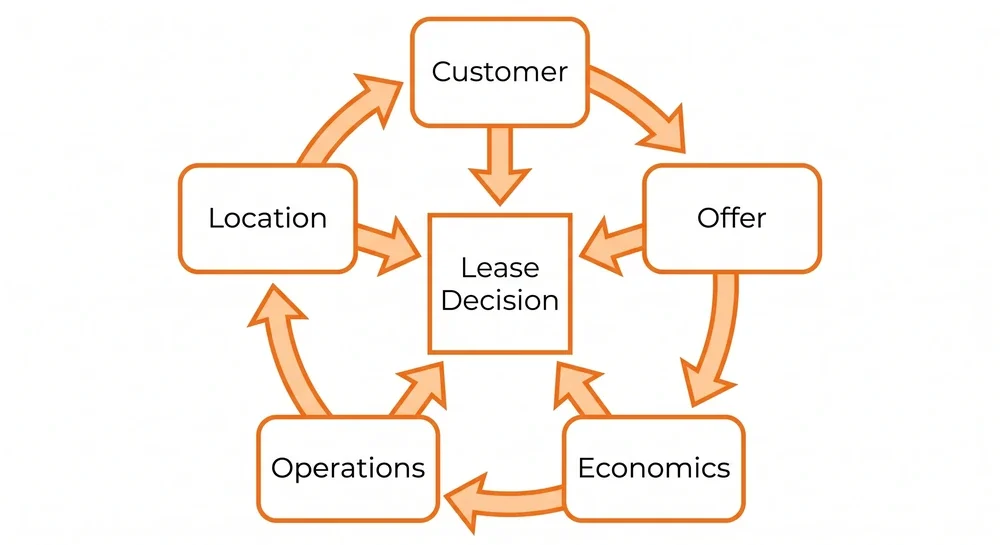
Step 2: Research Your Market
Now you need evidence that your concept fits the area you are targeting. This is where most aspiring operators skip steps because it requires work that does not feel like progress.
Competitor Audit
Visit every direct and indirect competitor within a 1.5 km radius of any location you are considering. Use a spreadsheet to track:
Menu items and price points
Peak-hour traffic (visit at lunch and dinner)
Online reviews — what do customers love and complain about?
Estimated covers per day (count tables × turnover)
Their unique selling proposition (USP)
Pro tip: If there are already 5 Italian restaurants within a 1 km radius and you are planning a 6th, your concept needs a very clear differentiator.
Demographic Fit
Use local census data or tools like SCAN soil maps (Ireland) or Local Data Company (UK) to check:
Daytime population vs. residential population
Average household income in the area
Footfall patterns (morning rush, lunch, after-work)
Nearby anchors (offices, gyms, schools, hospitals)
Step 3: Build a Lean Financial Model
You do not need a full 50-page business plan. But you do need a lean financial model that tells you whether the numbers work. Include:
Startup costs: Fit-out, equipment, permits, legal fees, opening inventory, working capital.
Monthly fixed costs: Rent, rates, insurance, utilities, staffing, software subscriptions.
Variable costs: Food cost (target 28-32%), packaging, marketing.
Revenue projections: Conservative, realistic, and optimistic scenarios based on covers per day.
⚠️ Warning: Your rent should not exceed 15-20% of projected gross revenue. If the lease puts you above that threshold, walk away.
Step 4: Test Before You Lease
The lowest-risk way to validate a foodservice concept is to test it before committing to a long-term lease:
Pop-up / residency: Rent a kitchen in an existing venue for 1-3 months. Test your menu, pricing, and operations with real customers.
Dark kitchen trial: Use a shared commissary kitchen and delivery-only model to validate demand without a dining room.
Market stall or farmers market: The ultimate low-cost test. Set up a stall, sell your food, and talk to every single customer.
Catering or pre-order model: Start by catering office lunches or accepting pre-orders through social media.
Data point: According to a 2025 study by the Restaurant Owners Association, concepts that tested via pop-up before signing a lease had a 42% higher 2-year survival rate.
Step 5: Evaluate the Lease
Once you have validated demand and confirmed the numbers work, it is time to evaluate the lease itself. Bring a solicitor who specialises in commercial leases. Key terms to negotiate:
Rent-free period: Aim for 3-6 months rent-free for fit-out.
Break clause: At year 2 or 3 — not year 5.
Rent review caps: Annual increases capped at CPI + 2% maximum.
Repair liability: Full repairing lease (FRI) is standard but negotiate a cap on structural repairs.
Permitted use: Ensure the lease explicitly allows your specific foodservice use (cooking, extraction, waste disposal).
Validation Checklist
Before you sign anything, confirm all of the following:

☐ Concept defined in one sentence ✓
☐ Competitor audit completed ✓
☐ Demographic fit confirmed ✓
☐ Financial model shows positive cash flow by month 6 ✓
☐ Concept tested with real customers ✓
☐ Lease terms reviewed by a solicitor ✓
☐ Rent is ≤ 20% of projected revenue ✓
Bottom line: A lease is a 5-15 year commitment. Spending 4-8 weeks on validation is not a delay — it is the best investment you can make in your restaurant's future.


Responses (3)